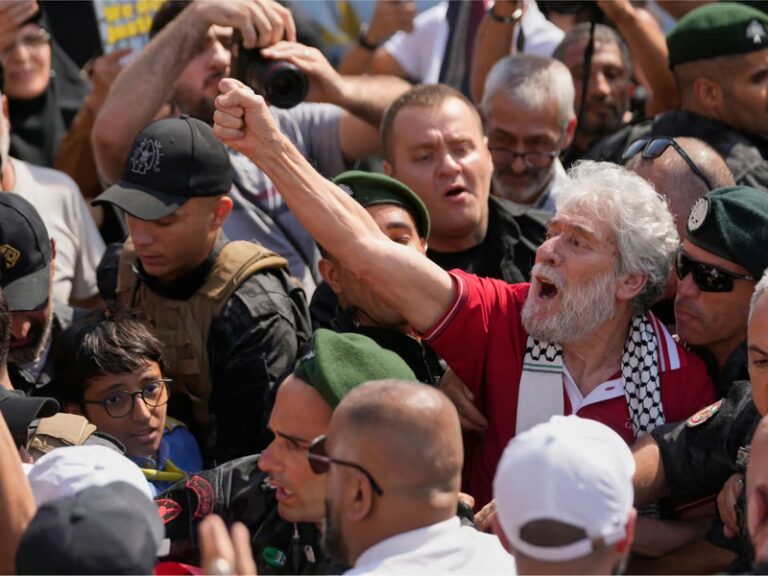
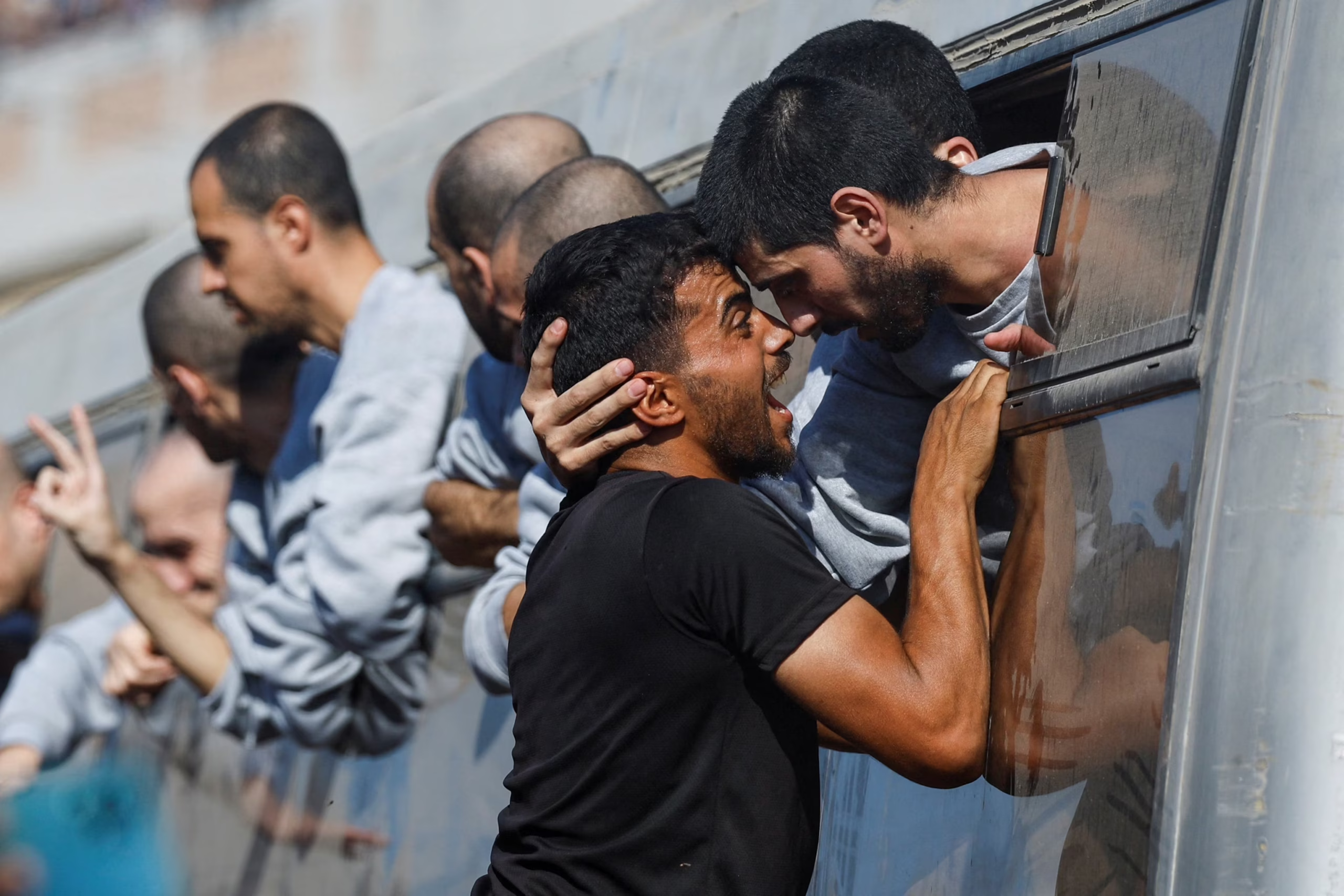
A man greets a freed Palestinian prisoner, recently liberated at the hands of the Resistance, as part of the Toufan Al-Ahrar (طوفان الأحرار, The Flood of the Free) prisoner exchange on October 13th, 2025
Our comrades from Canada Palestine Association’s Basil Al-Araj Committee recently wrote a politically clarifying piece on the insistence of using the term “prisoner” to describe Palestinian prisoners, over “hostage”, such as what is used when referring to Zionist captives.
Al-Ahrar Toronto is re-publishing this piece and affirms the necessity behind this if we are to continue strengthening and advancing our solidarity movement with Palestinian prisoners. Free them all!
—
A Palestinian Political Prisoner is actively resisting a colonial regime and occupation. They lead hunger strikes inside prison walls, organize against their jailers, teach each other history and politics, and remain a core part of the Palestinian national movement. Calling them hostages erases their agency, their struggle, and their political vision. To call them “hostages” frames their captivity as an isolated, accidental event, stripped of all history and cause.
In colonial language, a “hostage” is framed as an innocent, passive victim of circumstance, requiring rescue by a third party. This framing cannot be applied in the context of Occupied Palestine, for it depends on a false premise of symmetry and deliberately obscures the political reality there. You cannot equate the occupier and the occupied. An occupier is the foreign and violent agent imposing a regime of dispossession. The occupied are a people defending their land, their identity, and their right to exist. Therefore, the captives of the occupier are not “hostages” taken in a symmetrical struggle. They are political prisoners who are imprisoned for their resistance against occupation. Whereas Israeli hostages were taken as a bargaining chip. They are occupiers, and not innocent.
The movement inside Israeli prisons is called, in Arabic, الحركة الأسيرة (al-Haraka al-Asra)—The Captive Movement. The word for its members is أسرى (Asra), which translates to prisoner/political captive. This is a precise, revolutionary declaration of identity and cause.
أسرى (Asra) specifically refers to those captured by a foreign, colonial power. Its use is a direct assertion that their imprisonment is an act of war by an occupying force against people fighting for its existence. They are not criminals, and they are not random victims. They are captives of a political conflict, soldiers on the intellectual and organizational frontline of the anti-colonial struggle.
Hostages wait for Rescue. Political Prisoners organize for liberation. Using “hostage” frames the solution as a prisoner swap, which is a temporary, depoliticized fix. Calling them Political Prisoners makes clear that liberation and freedom will only come when the system imprisoning them is dismantled. Liberation of the political prisoners is inseparable from the liberation of Palestine. By naming them Political Prisoners we refuse to sanitize the violence of the carceral state and insist on defining reality from the perspective of the colonized, not the colonizer.
Colonial powers have always renamed liberation fighters as criminals and terrorists. This is a linguistic tactic to delegitimize the cause and sanitize the violence of the colonizer. By calling them Political Prisoners, we reject this colonial renaming. We reclaim their identity as part of a long history of anti-colonial resistance, in Algeria, in South Africa, where incarceration was a tool of empire and political prisoners were its frontline opponents.
References
Addameer Prisoner Support and Human Rights Association. Prisons as a frontline of genocide: Two years of war crimes against Palestinian political detainees.
Kates, C. The Palestinian prisoners’ movement as central to the Palestinian liberation struggle.
Omar, W. Why using ‘hostage’ erases the struggle of Palestinian prisoners. The New Arab.
Springer, D. M. If we abandon our political prisoners we abandon ourselves—Palestine shows us why. Mondoweiss.