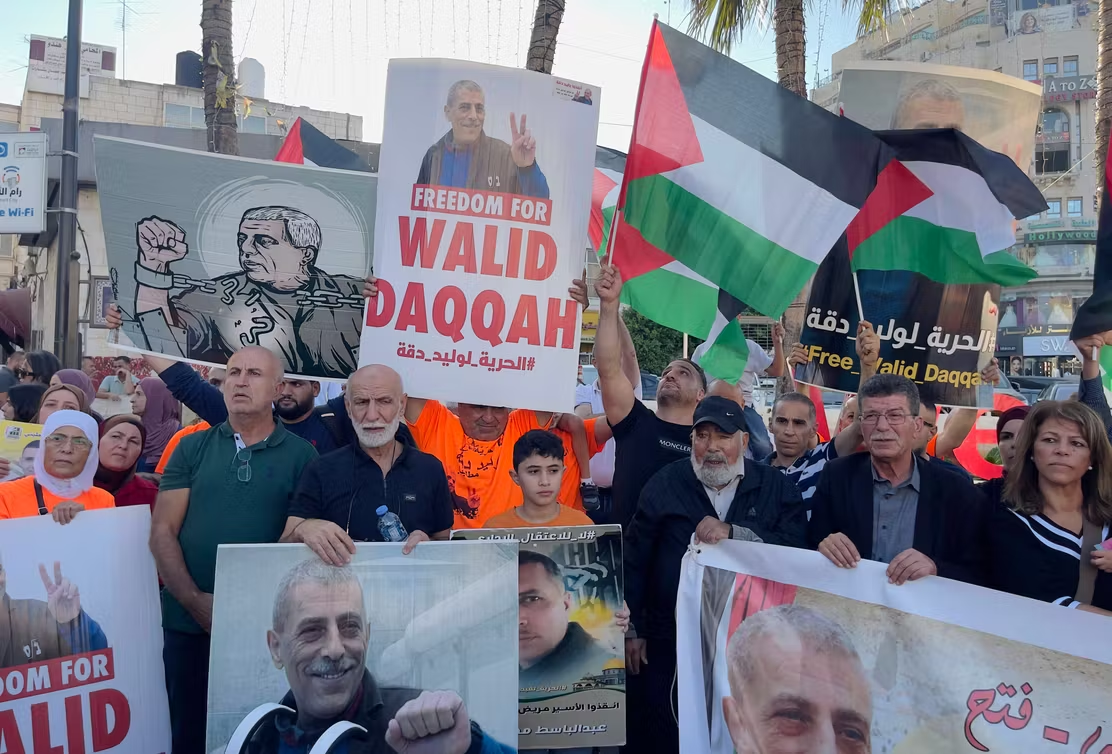
Demonstration in solidarity with prisoner Walid Daqqa and other Palestinians held in Zionist jails, in Ramallah, West Bank, on August 26, 2023. AHMAD AROURI/IMAGO VIA REUTERS.
Today, April 7th, marks the second anniversary of the martyrdom of Palestinian revolutionary leader, political prisoner, and intellectual giant Walid Daqqa. Daqqa spent a 38 years in Zionist prisons for his role in the Palestinian resistance in 1986. He died of medical neglect in Zionist custody after fighting cancer for several years.
Al-Ahrar Palestinian Prisoner Support salutes the martyr leader and his family as they continue the fight to retrieve his body from Zionist capture.
Impact on the Palestinian Prisoners’ Movement
Walid Daqqa has had a profound impact on the Palestinian prisoners’ movement and the wider liberation movement within Palestine. Daqqa’s writing is is a critical part of the intellectual tradition of the Palestinian liberation struggle. He offers us a profound and succinct analysis about the conditions of Palestinian prisoners in Zionist prisons and connecting their reality to the reality of all Palestinians under Zionist occupation.
In his piece titled “Consciousness Molded or the Re-identification of Torture”, Daqqa writes:
“Prison as an example is the subject of this study: the state of losing the ability to interpret reality, the feeling of impotence and the loss of initiative are not only the fate of prisoners; this description applies to all Palestinians. The similarity of the conditions of Palestinian citizens to those of prisoners is not restricted to the form of oppression, in which the citizens are closed off in separate geographic enclaves, just as prisoners are isolated from one another in wings and in sectors, totally dependent upon the will of the jailer. The essential similarity relates to the purpose of the jailer: to remold them according to an Israeli vision, by means of molding their consciousness, and especially by molding the consciousness of that fighting elite locked in prison. Therefore, in order to understand the general picture of Palestinian reality, it is worthwhile to study the life of the Palestinian prisoner, as a parable of the lives of civilians in the Occupied Palestinian Territories (OPT).”
Al-Ahrar mourns and commemorates Daqqa’s legacy by centering his writing and his teachings as our compass to uplift the struggle of Palestinian prisoners and the critical role they play in the liberation movement.
Glory to the martyrs!
Long live the Resistance!
Free, free Palestine!